Europe is entering winter 2026/27 with lower gas stocks and higher prices than at any point since the 2022 energy crisis, this time because of a disruption to LNG rather than to pipeline supply. Our article overviews first the European balance and the price signals, then reveals what nine months of Greek market data show, and finally considers the implications for the Greek gas market.
Contents
Europe enters the winter with limited room for error
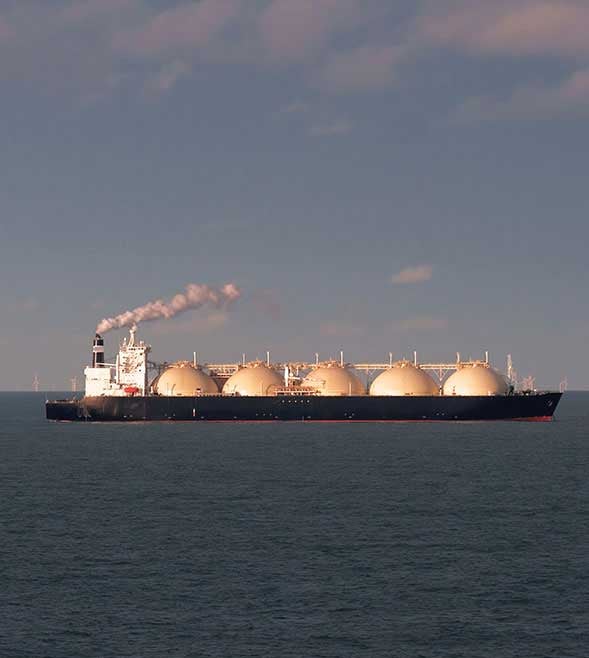
The conflict in the Middle East has altered the global supply picture. Since the closure of the Strait of Hormuz on 28 February 2026, more than 280 mcm per day of LNG, roughly a fifth of global supply and mainly from Qatar's Ras Laffan complex, has been unable to reach the market, and QatarEnergy declared force majeure on 4 March.¹ Although Qatar supplied only around 8% of EU LNG imports in 2025, Europe now competes with Asian buyers for the remaining flexible US cargoes, which can be diverted to whichever market pays the highest price.²
The shock arrived when European storage was already depleted. A cold winter 2025/26 left EU storage at only 28% on 1 April 2026, well below the 56% recorded on 1 April 2023 and the 34% recorded on 1 April 2025.² ³ ⁴ The injection season that followed was also challenging. On 1 October 2026 the EU held approximately 811 TWh, or 72% of working gas volume, against 940 TWh (83%) a year earlier.² The gap of around 130 TWh is roughly one and a half times the gas that flows through the Greek transmission system in a full gas year.
The comparison with the first winter after Russia's invasion of Ukraine is instructive. Then, as now, a geopolitical shock removed a major source of supply and Europe turned to LNG to replace it. Prices today are far below the 2022 peak, when TTF reached nearly €340/MWh in August.⁵ The physical buffer, however, is thinner: Europe had rebuilt its storage to 95% by 1 November 2022, approximately 1,060 TWh,³ ⁶ or around 250 TWh more than it holds today.
ENTSOG's winter assessment shows how narrow the margin has become. Under normal temperatures and adequate LNG, Europe closes the winter with storage at 29%; if LNG proves tight, at 13%. In a cold winter, demand would need to fall by 7% to 12% even after storage is drawn down to strategic reserves of 11%, which ENTSOG's model leaves untouched.² Releasing these reserves, roughly 125 TWh, could ease but not remove the 237–437 TWh of demand response that the cold-winter scenarios require.
However, the pressure would not end by the end of the heating period. The EU target is to fill storage to 90% between 1 October and 1 December, with Member States allowed to deviate by up to 10 percentage points in difficult market conditions and a further 5 points at the European Commission's discretion.² ⁷ From this October's 72%, ENTSOG finds that Europe could reach 90% by the end of September 2027 with adequate LNG, but only 65% if LNG remains tight.
The regional dimension is relevant for Greece, with ENTSOG pinpointing the landlocked countries of Central and South-Eastern Europe as the most exposed to LNG scarcity: on a cold-winter peak day, with storage at 35% and no Russian pipeline gas, unserved demand could reach 12% in South-Eastern Europe against 6% across EU.² Pipelines cannot carry enough gas from Western Europe's LNG terminals to the south-east, so the region relies more heavily on the routes through Greece.
The price signal: TTF at its highest level since 2022
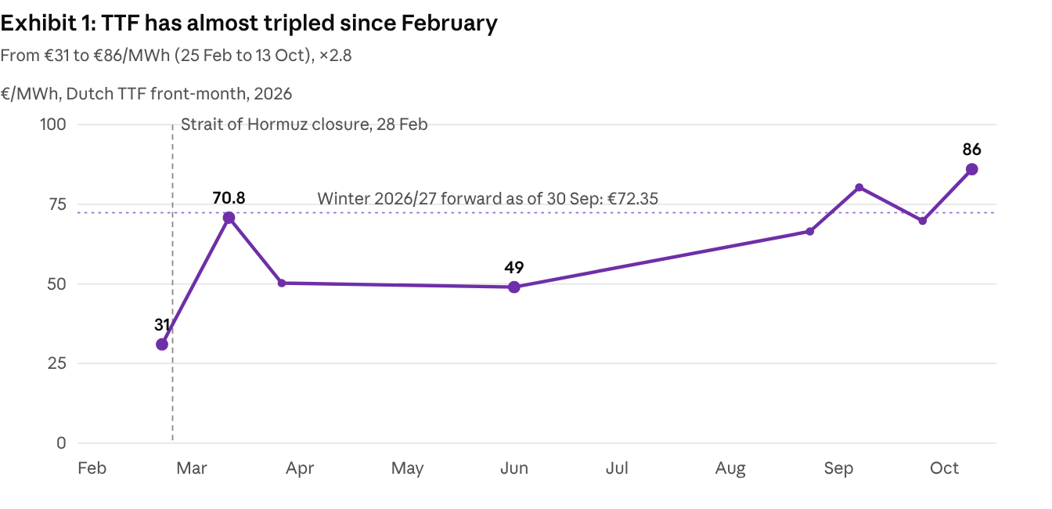
Prices have absorbed the supply shock in two waves. Before the crisis the market was well supplied, with TTF trading between €28 and €40/MWh in early 2026.⁸ The Hormuz closure triggered a rise of more than 60% in March, the largest monthly increase since September 2021,⁹ with month-ahead volatility reaching 160%.¹⁰
The ceasefire between Iran and the United States in April brought prices back to their lowest level since the start of the conflict,¹⁰ and TTF stood near €49/MWh in early June.⁸ The second wave began in late August as the storage refill fell behind schedule. TTF averaged €76.48/MWh in September,¹¹ crossed €80/MWh for the first time since 2023¹² and reached €86/MWh on 13 October, its highest level since December 2022.¹³
The forward curve suggests that the market sees the pressure as concentrated in the months ahead. On 30 September the winter 2026/27 contract traded at €72.35/MWh against €53.41/MWh for summer 2027, a backwardation of almost €19/MWh.² A year earlier the curve was almost flat, with winter 2025/26 at €31.72/MWh and summer 2026 at €30.46/MWh,¹⁷ so the winter contract is up by about 128% year on year. Spot prices have since moved above the winter contract, meaning that buyers are paying a premium for gas delivered now, even though the curve still points to lower prices from summer 2027.
For Greece, which buys LNG at prices indexed to TTF and has no storage inventory to smooth the shock, these levels pass almost directly into the cost of supply.
Greece: demand growth is entirely export-led
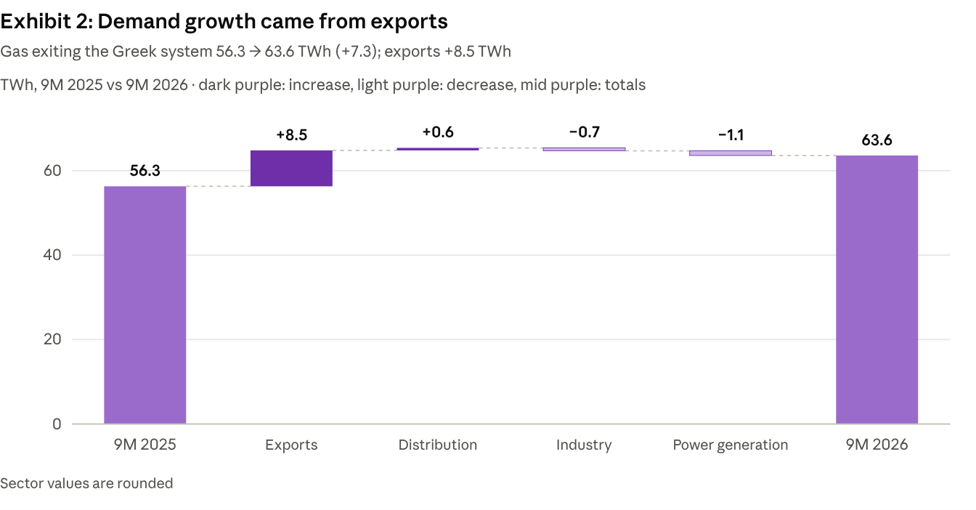
Our analysis of gas allocations at the exit points of the Greek transmission system shows a 13% rise in the first nine months of 2026, from approximately 56.4 TWh to 63.5 TWh.¹⁸ The headline figure masks two opposing trends: domestic consumption declined by 3%, from approximately 51.3 TWh to 49.9 TWh, while exports almost tripled (+169%), from approximately 5.1 TWh to 13.6 TWh.¹⁸ Without the 8.5 TWh increase in exports, Greek gas throughput would have declined.
Source: note 18, Gas Demand Structure by Sector, 9M 2025 vs 9M 2026
Within domestic demand, consumption through the distribution networks grew by 6% to approximately 10.0 TWh, while power generation declined by 3% to approximately 33.2 TWh and industrial use by 10% to approximately 6.8 TWh.¹⁸ Power generation nonetheless remains the anchor of the domestic market, at two thirds of domestic consumption.
September suggests that the export trend is structural rather than seasonal. As domestic consumption fell by 22% month on month, from approximately 5.6 TWh to 4.4 TWh, exports rose by 4% to approximately 1.74 TWh, or 28% of all gas exiting the system, on exceptionally strong external demand.¹⁸
With one in five cubic meters of gas re-exported over the nine months, Greece is no longer only a gas consumer. It has become a regional LNG gateway for South-Eastern Europe, the part of Europe that is most exposed in a constrained winter.
Greece: LNG has become the swing source of supply
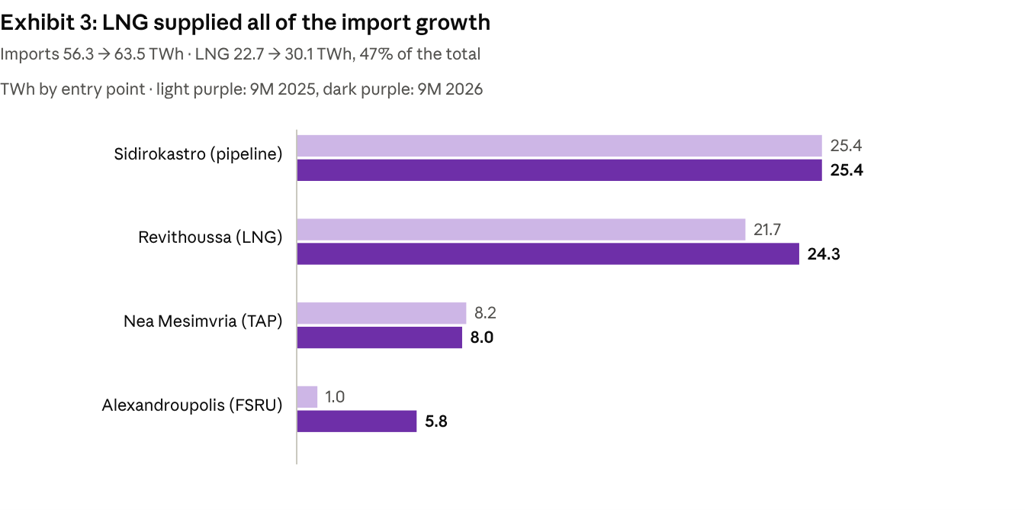
On the supply side, total imports grew by approximately 13%, and LNG accounted for all of that growth.¹⁸ Pipeline imports were broadly flat at approximately 33.4 TWh (−1%), with Sidirokastro, an entry point attributed to Russian gas, stable at approximately 25.4 TWh and TAP flows at Nea Mesimvria easing by 3% to approximately 8.0 TWh. LNG imports rose by 32% to approximately 30.2 TWh: Revithoussa added approximately 2.6 TWh to reach 24.3 TWh, and the Alexandroupolis FSRU added approximately 4.8 TWh to reach 5.8 TWh.¹⁸
Source: note 18, Gas Imports Evolution Comparison; 2025 values for Revithoussa and Alexandroupolis derived from the reported increases
LNG now covers almost half of Greek supply, which ties the cost of the Greek gas balance closely to the global LNG market described above. Alexandroupolis, meanwhile, has moved from marginal to material, providing much of the regasification capacity underpinning export growth.
DESFA data on Revithoussa, which handled about 80% of Greek LNG imports, add two further observations.¹⁹ The first relates to cargo size. Thirty-two cargoes carrying 24.25 TWh were unloaded in the first nine months of 2026, against 36 cargoes and 22.41 TWh a year earlier, reflecting a shift towards full-size cargoes of around 1 TWh in place of smaller deliveries of around 0.5 TWh. Larger cargoes lower the unit cost of supply, but in a system without storage each delayed or diverted cargo weighs more on the gas balance.
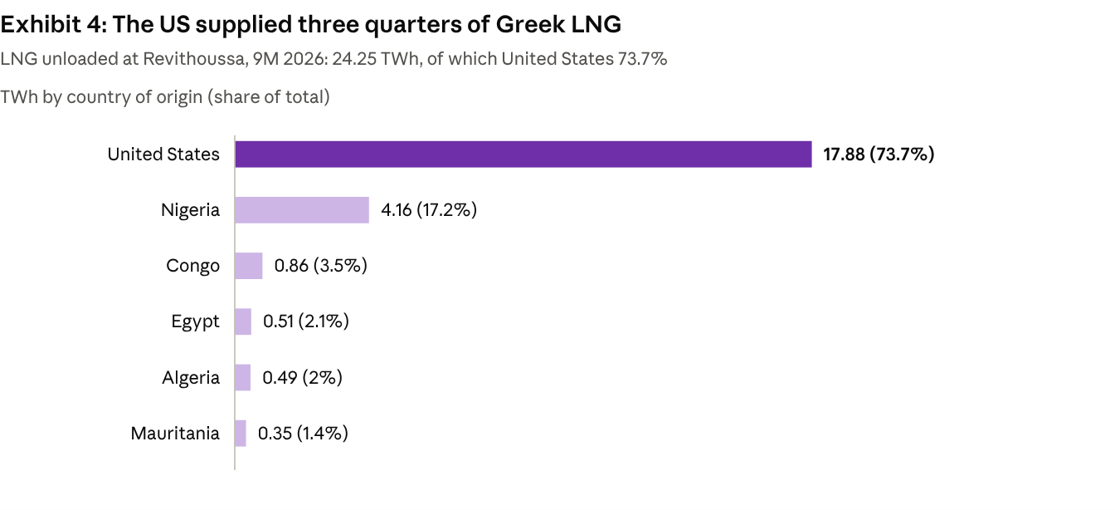
The second relates to the origin of supply. The United States supplied 17.88 TWh, approximately 74% of the total, followed by Nigeria with 4.16 TWh (approximately 17%); Congo, Egypt, Algeria and Mauritania together accounted for less than 10%.¹⁹ With one country providing three quarters of LNG volumes, there may be scope for Greek buyers to broaden their supply portfolio over time.
Source: note 19, DESFA natural gas consumption data for 9M 2026
No cargo unloaded at Revithoussa came from Qatar or elsewhere in the Gulf.¹⁹ Greece therefore appears not to be exposed in volume terms to the Hormuz disruption, but it is exposed through price, as its US and West African cargoes are traded in the same Atlantic Basin market for which Europe and Asia now compete.
September indicates how sensitive the LNG share is to market conditions. Imports fell by 17% month on month to approximately 6.1 TWh, with LNG down 24% to approximately 2.3 TWh, so that pipeline gas rose to 63% of supply.¹⁸ Lower demand explains part of the shift, with gas use for power generation down 31%.¹⁸ The rest reflects LNG's role as the swing source.
Within pipeline flows in September, Sidirokastro accounted for 76% and TAP for 24%.¹⁸ Over the nine months, Sidirokastro covered around 40% of Greek imports, volumes that will need to be replaced by November 2027 under the EU phase-out of Russian gas.² Greece and much of South-Eastern Europe will then depend on LNG, and therefore on TTF, for their marginal supply. To keep the 2027/28 heating period from facing the same price pressure, the EU and Member States could create incentives for medium- to long-term LNG contracts, for example through joint purchasing via the AggregateEU platform or state-backed credit support for buyers. Storage refilling for 2027 could also ideally start as early as possible and follow a smooth trajectory, using the flexibility already in the storage regulation to avoid a summer buying rush.⁷
What winter 2026/27 means for the Greek market
The price exposure is substantial. In September, power generation accounted for 50% of all gas exiting the system,¹⁸ so gas prices pass almost directly into wholesale electricity costs. Annualising domestic consumption suggests that every €10/MWh increase in TTF adds roughly €0.67 billion a year to the cost of gas consumed in Greece. At the gap between February levels of around €31/MWh and the €86/MWh of 13 October, the implied burden is in the order of €3.7 billion a year if sustained. These figures are illustrative, as they assume all volumes are priced at TTF; hedging, or longer-term contracts with fixed or alternative price indexation, can reduce the exposure materially.
The export success also creates an operational trade-off. In a cold spell, demand in the importing markets to the north would peak at the same time as Greek heating and power demand, competing for the same regasification and transmission capacity. Capacity allocation and emergency rules exist at national and EU level, but they have not yet been tested against a regional cold spell in which domestic and export demand peak together. Without such a test, Greece's role as a regional hub could become a source of domestic tightness.
Implications for the Greek gas market
In 2026 Greece has moved from being a peripheral gas consumer to a functioning regional gateway. This is a strategic asset for the country and for South-Eastern Europe, and it has been delivered by infrastructure that is already in place. The Greek market also carries a more concentrated risk profile than Europe as a whole: no storage, high exposure to spot LNG, a power sector that absorbs two thirds of domestic demand, and a large pipeline supply stream to replace by November 2027. In our view, this new reality points to four potential areas in which market stakeholders could take action.
Securing supply before the market tightens further
Greek suppliers and large consumers could lock in a share of their winter and 2027 requirements through medium- to long-term or portfolio LNG contracts rather than relying on shorter-duration products, while broadening a supplier base that already includes Nigerian, Egyptian, Algerian and other West African cargoes. Over the medium term, the absence of underground storage remains the largest structural gap in the Greek system, and closing it could be treated as a security-of-supply priority rather than a commercial option.
Managing the hub role deliberately
The growth of exports is welcome. The existing rules for capacity allocation and emergency supply could be stress-tested for a simultaneous domestic and export peak, and coordinated with neighbouring transmission operators before the first cold spell, a step that ENTSOG's findings on South-Eastern Europe make a regional as well as a national initiative.¹
Preparing proactively for the replacement of Russian volumes
The Sidirokastro flows could be replaced by additional LNG through Revithoussa and Alexandroupolis and by higher utilisation of TAP.
Managing the pass-through of gas prices into electricity costs
Suppliers and industrial consumers already adopt systematic hedging strategies, layering forward purchases over a 12- to 24-month horizon and using swaps or price collars to cap exposure. Gas-to-power producers can lock in clean spark spreads by hedging gas and electricity together, and large industrial users can secure fixed-price power purchase agreements, including with renewable assets. At the same time, Member States are already fostering flexibility resources, such as battery storage and demand response, that reduce the number of hours in which gas-fired plants set the price.
The winter ahead will test whether Greece's new role as a regional hub is matched by the preparedness to sustain it. The infrastructure is in place; the next step is to build the contracts, rules and risk-management practices around it.
U.S. Energy Information Administration, International LNG prices rise amid Strait of Hormuz closure, Today in Energy, 2026.
ENTSOG, Winter Supply Outlook 2026/27 with Summer 2027 overview
U.S. Energy Information Administration, Europe ended winter 2022–23 with the most natural gas in storage on record
European Commission, Gas storage
GIS Reports, LNG imports helped stabilize European gas markets
Gas Infrastructure Europe, EU's underground gas storage is ready for winter, press release, 9 November 2022
European Parliament, Legislative Observatory, Role of gas storage for securing gas supplies ahead of the winter season, 2025/0051(COD)
European Central Bank, Energy shock: why oil and gas prices have risen less than expected, ECB Blog, 27 July 2026.
Trading Economics, EU natural gas – market news, 25 February 2026 and March 2026 updates.
International Energy Agency, Gas Market Report Q2-2026, Executive summary.
Cbonds, Natural gas TTF index, September 2026 statistics.
Global Oil Shock, TTF Gas Price: Europe's Gas Benchmark, Explained, TTF as of 11 September 2026.
Trading Economics, EU Natural Gas – Price, Chart, Historical Data, News
LNG Price Index, March 2026 LNG Price Review.
Tacto, Natural Gas Price Today, TTF front-month as of 28 August 2026.
The Traders' Spread, TTF Gas Price Prediction, ICE Endex settlement of 29 September 2026.
ENTSOG, Winter Supply Outlook 2025/26 with Summer 2026 overview
GT analysis
DESFA natural gas consumption data for the nine-month period ended September 2026
Related Services
We work at an impressive pace. Yours. Discover how:
The strategic resilience of the Greek gas market is predicated on the optimization of its supply dualism: the baseline stability of fixed pipeline infrastructure and the high-degree flexibility afforded by LNG imports.
Greece is currently navigating a fundamental strategic shift in its energy sourcing, characterized by a transition from traditional pipeline-heavy reliance toward a flexible, LNG-centric import model.